
Slowing Down on Vacation
Why Most Offerings Achieve the Opposite
"Slowing down" now appears on offerings that contain a daily schedule with eight items. The contradiction is not accidental - it follows from the fact that quiet is hard to sell.
There is a structural problem with offerings that promise to slow you down: a business selling deceleration has to offer something for it. Offering something means setting appointments. Setting appointments is the opposite of slowing down.
That is nobody's fault - it is the logic of the trade. But it explains why so many people come back from a "slow-down weekend" and find that nothing has changed: they had two days of appointments, only nicer ones.
What slowing down actually means
Slowing down is not an activity but an absence. Specifically, the absence of three things:
Of scheduling. A day made of consecutive time slots - breakfast, treatment, lunch, class, dinner - is scheduled, even if every single slot is pleasant. The body does not distinguish between an appointment at the accountant's and an appointment for a massage. It distinguishes between "I have to be somewhere at two" and "I do not".
Of decision density. The second fatigue factor on holiday is underestimated: where do we eat, what do we do tomorrow, will we make it, should we book. Twenty small decisions a day cost more energy than one large one.
Of being observed. Moving through an environment where you are seen - lobby, breakfast room, pool area - means running a quiet self-management in the background. That is no tragedy, but it is not recovery either.
The difference between slow and empty
Slowing down does not mean working through the same program more slowly. It means there are hours in which nothing is scheduled - and in which the question "so what now?" simply does not arise, because it does not need an answer.
Why it takes two to three days
There is a recurring pattern that many guests describe themselves.
Day one: you are faster than your surroundings. You get up early, you are ready quickly, you wait. The urge to do something is strongest on the first day - not because you want to, but because doing nothing is unfamiliar.
Day two: the clearing out. Everything left open at home surfaces. Many people spend this day handling things that have nothing to do with the holiday - emails, calls, lists. That is not a relapse but a necessary intermediate step.
From day three: the point at which the pace shifts. You wake up without immediately knowing what is next. You go outside without a destination. You read a page and afterwards know what was on it.
Leave after two nights and you experience the first two days and conclude that slowing down does not work for you. It simply had not started. How much time is realistically needed is covered under Time Out in Styria.
What actually helps
Four things that work in practice - and none of them is bookable:
A place without time slots. The strongest single lever. No breakfast buffet with a closing time, no housekeeping driving you out of your room, no dinner with a table reservation. Why an apartment delivers that and a hotel structurally cannot is under Vacation Without a Hotel.
Fewer decisions. Shopping once for three days removes nine decisions from the stay. One outing a day instead of three removes more.
A short way outside. Slowing down consists largely of short, aimless walks. If a car journey is required, they do not happen. What starts directly outside the door in Stainz is under Hiking and Walking in West Styria.
An activity with its own speed. Cooking, walking, reading, a wine you do not drink but taste. Activities you cannot accelerate are the most reliable decelerators - which is the subject of our piece Wine and Time.
What does not help
A full wellness schedule. A change of place for one night. A holiday where you put the phone down but check it every two hours. And treating slowing down as a goal you have to reach - which reliably turns it into another task.
What a slowed-down stay looks like in practice
Not as a prescription, but as an example over four days:
Arrival day. Shopping, unpacking, nothing else. No outing, no restaurant.
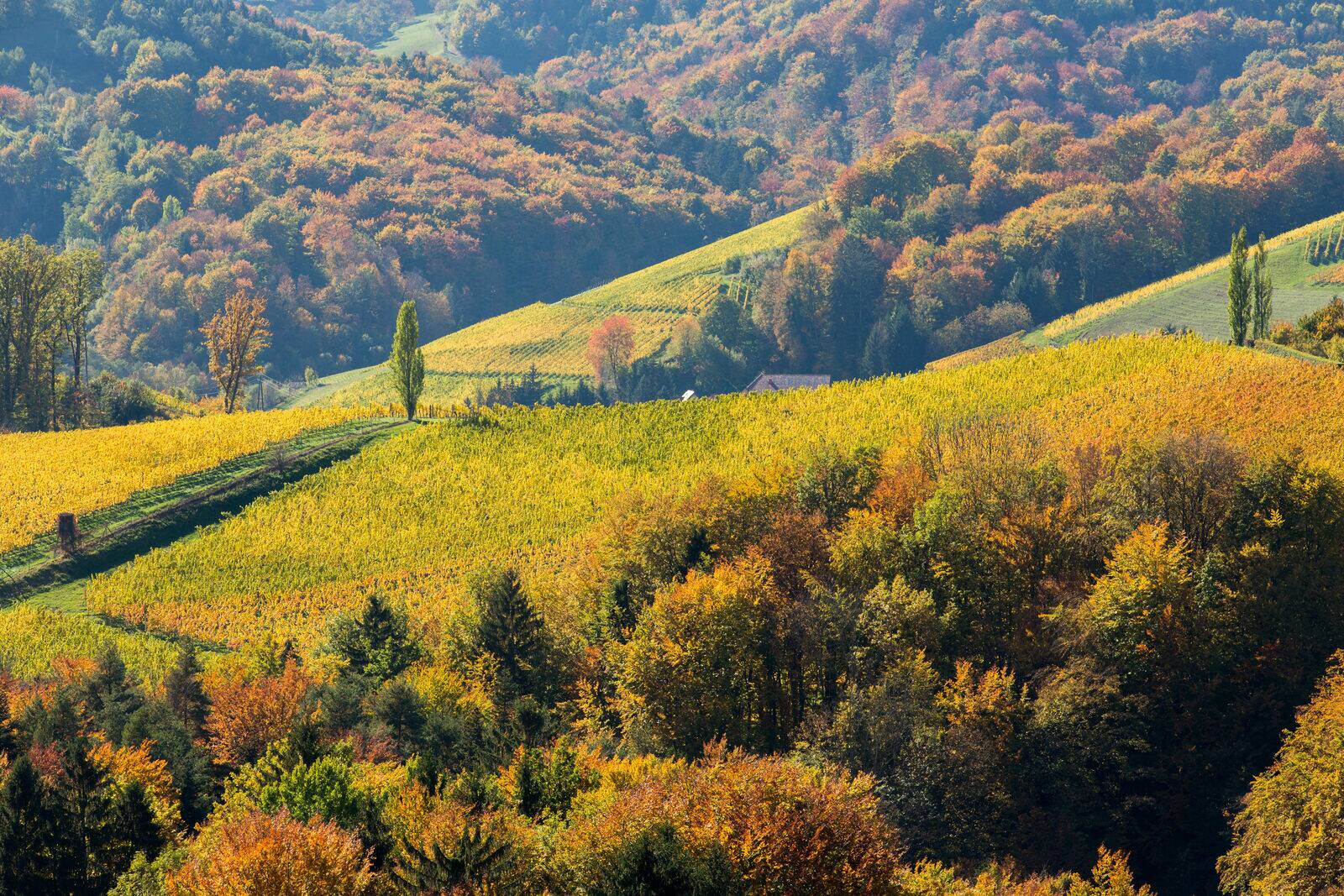
First full day. One item in the morning - a walk through the vineyards, say, or a visit to the village. Afternoon open.
Second full day. No item at all. If something comes up, it comes up. In our experience, the day on which the most unplanned things happen.
Departure day. A late start. Finish packing two hours before leaving, then sit outside again.
Fill that pattern with six outings and you have a good holiday - but not a slowed-down one. Both are legitimate; it just helps to know which one you are booking.
Three misunderstandings
"Slowing down means doing nothing." No - it means having to do nothing. A day spent walking in the vineyards for eight hours, cooking and reading is slowed down. A day spent lying on a sun lounger for eight hours while checking the phone every twenty minutes is not.
"You need a special place for it." The place does not have to be able to do anything. It only has to not do certain things: set times, enforce encounters, create expectations. That is a list of absences, not a list of amenities - which is why many expensive houses fail it and some simple ones pass.
"Slowing down is for people with lots of time." The effect needs time, the entry does not. The single most effective step - shopping once for the whole stay and thereby deleting nine decisions - takes half an hour.
Slowing down over a weekend
The most common question, and the least comfortable answer: two nights will not change your pace. The sequence described above ends exactly where it gets interesting.
What a weekend can still do is interrupt - and that is not worthless. It simply works differently: not as a reset but as a break in a run of weeks that would otherwise have gone straight through. How to plan two nights so they do not turn into a short break with a program is described under Time-Out Weekend.
The rule of thumb stands: if you want a change, take three to four nights. If you want an interruption, a weekend is enough - provided you don't call it time out and expect accordingly.
How you know it worked
Not from how rested you feel on departure - that happens after a full holiday too, and lasts about as long. Four other signs are more reliable, and all four appear only after you get home:
- The first working day feels like a working day, not like a re-entry.
- You remember hours in which nothing happened - not only the program items.
- You continued a book during the stay instead of merely packing it.
- The thought of the next holiday arrives as anticipation, not as a need.
Anyone who gets home and finds none of the four applies usually did not have too short a stay but too full a one.
Why West Styria suits it
Less for what it has than for what it does not: no attraction that coaches stop for, no pedestrian zone with souvenir shops, no ski season with lift operations. Alongside that, landscape you do not have to visit, because you live in it.
What there is: paths that begin outside the door, wine taverns with irregular hours, vineyards, and a stream. Why this area sits below the tourist radar is under Why Stainz and West Styria Lie Beyond the Classics and Finding Peace in South West Styria.
Slowing down cannot be booked, but it can be made possible - by a place that sets no times. The five apartments at Johann & Anna in Stainz have their own kitchens, a garden by the stream, and no reception.
What does slowing down on vacation mean in concrete terms?
Less scheduling, fewer decisions, less being observed. Not the same program more slowly, but less program.
How long does it take before slowing down sets in?
Usually two to three days. A weekend tends to end exactly at that point.
Do you need yoga or meditation for it?
No. If it appeals to you, it is under Mindfulness Vacation in Styria - it is not necessary.
Is a wellness hotel a place to slow down?
It can be, but it works structurally against it: treatments are appointments, and appointments schedule the day.
Does slowing down work with children?
Differently, but yes. The lever is the same - fewer scheduled items per day - only the floor is higher.
Do you have to go offline?
Not necessarily. If you want to try the stricter version, it is under Digital Detox Weekend.