
Workation Styria
Working by the Stainzbach, Barely 300 Meters from the Vineyard
Workation Styria doesn't mean a co-working lounge with kombucha on tap here — it means five apartments on the Stainzbach stream, a workspace with an actual door, and a place where nobody asks how long the laptop's been open.
Anyone searching for "workation Styria" usually isn't looking for a hashtag, but for a fairly concrete answer: is there actually a place to work here, or just a room with a nice view and a wifi password taped to an index card? In Stainz, in West Styria, the answer is: a separate workspace in the Johann apartment, a garden on the Stainzbach stream for the breaks in between, and a house that makes no demands on how you structure your day. Workation Austria tends to get associated with the same three or four places — Stainz isn't one of them yet, which, for anyone looking for quiet rather than a scene, is more of an advantage than a drawback.
This isn't another essay on why workations are a good idea in principle. It answers the practical questions that are actually open before booking: how reliable is the internet, how long do guests typically stay, is there a real desk — and who the whole thing is actually suited for.
What Workation Actually Means Here
The term tends to get used more broadly than it's meant here. At Johann & Anna, workation doesn't mean a laptop at the breakfast table while a coffee machine hisses in the background and three other guests talk about the weather. It means your own apartment with your own door, your own kitchen, and — in the Johann apartment — a workspace that's physically separate from the living room and bedroom. You close the door and you're at work, not on a vacation that's currently being interrupted.
That's what sets an apartment apart from a hotel room, where the desk is usually a side table doing double duty, with the room key card sitting on it during the day. It also sets it apart from a classic co-working space in the city: nobody has to commute, pay a day rate, or share a room with strangers whose video calls echo across the space. The distance from the coffee machine to the desk is a few steps, not a drive.
What this format isn't: a tightly scheduled routine with a prescribed morning ritual and a shared breakfast table for all guests. There's no programme, no mandatory networking rounds, no instruction on when the day is supposed to start. Anyone who wants to work, works. Anyone who wants to spend an hour by the stream does that just as undisturbed.
A Workspace with a Door, Not Just a Table
In the Johann apartment, the workspace is separated from the living area — no walk-through room, no laptop balanced on the coffee table. Anyone working with focus for a few days or weeks notices the difference most in the afternoon, when concentration starts to slip and a closed door is worth more than a nice view.
Wifi, Power, Desk: The Technical Reality
The honest answer first: Stainz is a small market town in the Schilcherland, not a tech hub. The internet runs on a fixed line with solid speed for the region — enough for video calls, cloud uploads, and several devices at once, but without the gigabit promises some workation providers make in cities. For most office work — writing, research, video calls with the camera on — the connection holds up reliably. Anyone moving large video files in both directions on a daily basis should just say so beforehand — the answer to that is more honest than a blanket "sure, no problem."
There are enough power outlets right at the workspace itself — no extension cord improvised across the room. A real office chair instead of a dining chair, a table at working height instead of a decorative side table — that sounds obvious, but in many vacation apartments it isn't. At Johann & Anna, the workspace in the Johann apartment was actually built as a workspace, not relabeled as one after the fact.
Remote Work in Styria: What's Missing Outside the Apartment — and What That Means
Anyone coming from a big city won't find a choice of third-wave coffee shops doubling as co-working spots in Stainz, the kind where you switch locations between two meetings. There's a village inn, a bakery, a couple of wine taverns within walking distance — but no backdrop of laptop stickers and kombucha on tap. For some, that's a shortfall. For anyone who wants a workation precisely to get away from café noise, it's the actual point: the workplace is your own apartment, not the hunt for a table with a power outlet in someone else's café.
Graz is about 40 minutes away by car, for anyone who does need urban infrastructure now and then — a co-working space with a community, a client meeting, an outing on a free afternoon. For the day-to-day of the workation itself, though, that drive isn't necessary.
How Long Guests Typically Stay for a Workation
Demand roughly splits into two groups. The first comes for an extended weekend, three to four nights, usually to finish off a single project or clear a head that's gotten clogged up by everyday life at home. The second stays longer — one to two weeks — often combined with a few free days at the start or end of the stay. There's no fixed minimum stay for workations; as with any booking, it depends on the season and gets settled directly when you inquire.
What stands out: guests arriving for a pure workation rarely stay shorter than three nights. A single day barely pays off given the travel time, and the actual effect — a head that genuinely quiets down, work that genuinely sharpens — usually only kicks in on the second or third day, once the rhythm of the place has settled in.
After Work: Garden Instead of Lobby
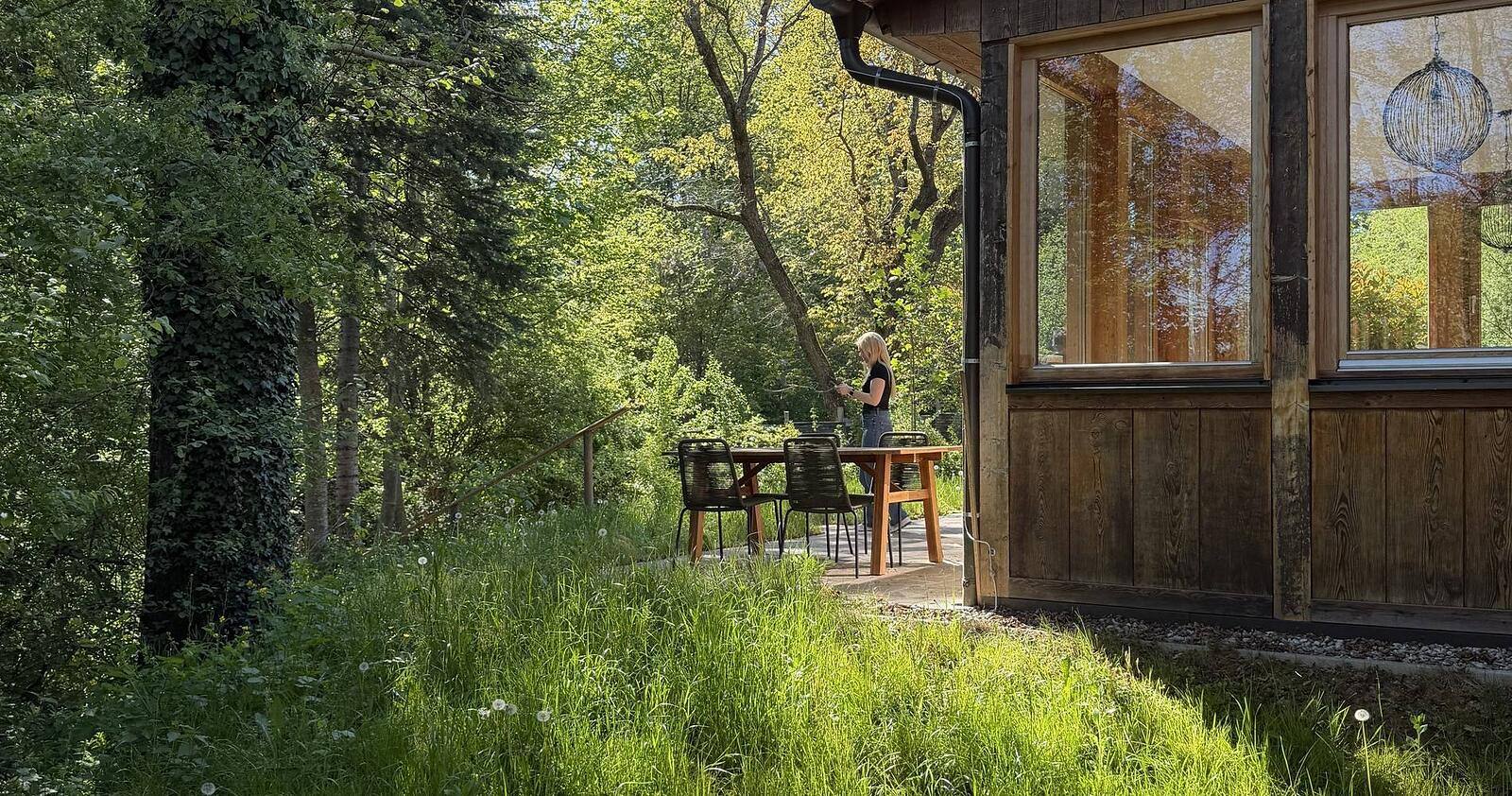
No hotel restaurant, no lobby with muzak, no question about whether you'd like to spend the evening in the spa area. The garden and terrace are right outside the door — a few steps are often enough for the transition between the end of the workday and private life, not an outing.
Who a Workation in Stainz Suits — and Who It Doesn't
Individuals with work that can be planned ahead — writers, consultants, anything that can be done with a laptop and a stable connection — find the combination of retreat and infrastructure here that a plain vacation apartment without a workspace doesn't offer. Couples where one person works and the other has time off benefit from the physical separation: whoever's working closes the door; whoever's off doesn't have to overhear it. Small teams of roughly four to six people can, on request, book several of the five apartments together — for an overnight strategy day, a small offsite, or a project week away from the office. Anyone who needs sturdier capacity or a shared meeting room for something like that will find the more detailed terms on the page about the retreat location for small groups.
The format suits less well anything that depends on constant office-level speed: teams of ten or more, daily in-person meetings with clients, or work that relies on specialized technical infrastructure on site. And anyone who actually wants a classic vacation and is only dragging the work along out of a guilty conscience is probably better served by a real break than by a half-hearted workation.
An Apartment, Not a Co-Working Space — the Difference Day to Day
Maybe the most important detail: there's no shared lounge here where guests are meant to network, and no curated "community" with name tags. Anyone working in the Johann apartment does so on their own — or as a couple, if traveling together. That's a deliberate choice, not a gap in the offering. Anyone specifically looking for exchange with other workation guests will find that more readily in larger houses in cities that specialize in that audience. Anyone looking for their own focus will find here what's actually meant by a workation apartment: a complete, self-contained apartment with a workspace, not shared infrastructure.
This same restraint shows up on arrival, too. There's no reception desk, no check-in small talk you might not have wanted anyway. A brief, personal conversation when the keys are handed over, then as much or as little contact afterward as you'd like — for guests who really just want to work, that's often exactly the difference that makes the stay bearable.
How This Differs from a Classic Vacation
Anyone still unsure whether a workation is even the right format — as opposed to a classic vacation or a themed retreat — will find a more detailed comparison in Retreat vs. Workation vs. Vacation. In short: on a workation, the work continues, only the place changes; a retreat centers on a specific theme with guidance; a classic vacation runs on a density of experiences rather than on reduction. Anyone who wants to know what a concrete work weekend in the Johann apartment actually feels like will find the more personal, less list-like version of this text in the first-hand account Writing, Thinking, Arriving.
Anyone interested in the stay itself — regardless of the work component — will find the broader overview of all five apartments, the region, and getting here on the page about the vacation apartment in West Styria.
Getting Here and the Surrounding Area
By car, Stainz is about 40 minutes from Graz, and roughly two and a half to three hours from Vienna. Anyone coming by train travels to Graz or Deutschlandsberg and takes a regional connection or a taxi from there for the last few kilometers. Parking is available right on the property. For a workation, where outings are rarely on the agenda anyway, the exact distance matters less than it would for a classic vacation — still, it's reassuring to know that Graz isn't half a world away if you need it.
Whether Stainz suits your own workation is easiest to answer by looking at how you work: anyone who needs a separated workspace and reliable, but not urban, infrastructure will find a concrete answer to that in the Johann apartment.
The nationwide overview - regions, criteria, and legal questions - is under Workation Austria.
See availability for the Johann apartment — or ask directly about a workation inquiry, including questions about internet speed or length of stay.
How reliable is the wifi for a workation in Stainz?
The fixed internet connection reliably handles video calls, cloud-based work, and several devices in use at once. Anyone who regularly transfers very large amounts of data should mention that briefly before arrival.
Is there a real desk, or do I have to work at the kitchen table?
The Johann apartment has a separate workspace with its own table at working height and enough power outlets, physically separated from the living area. In the other four apartments, you can work at the living room or dining table, but a dedicated workspace only exists in Johann.
What's the minimum stay for a workation?
There's no fixed minimum, it depends on the season and gets settled when you inquire. In practice, at least three to four nights is usually worthwhile — shorter stays often get lost in the everyday shuffle because of the travel time.
Does Stainz also work for a small team, not just individuals?
Yes, on request several of the five apartments can be booked together, for instance for an offsite or a project week with four to six people. For larger groups or if you need a shared workspace, it's worth a look at the retreat location for small groups.
What sets a workation here apart from a co-working space in Graz?
Mainly the privacy and the absence of a commute: no shared space with strangers' video calls in the background, no drive to the workplace, but instead a self-contained apartment with a kitchen, a garden, and a workspace that turns back into living space once the workday ends.
Do I need to book a specific apartment for a workation?
The actual workspace with a separate room only exists in the Johann apartment. Anyone more flexible, who can work at a living room or dining table, will find enough quiet for that in all five apartments.